
REST API
The Phantom REST API lets your own services read state from and act on the servers you administer through Phantom — moderation cases, economy balances, levelling, tickets, giveaways, the Phantom Network — and lets you receive outbound webhooks when interesting things happen.
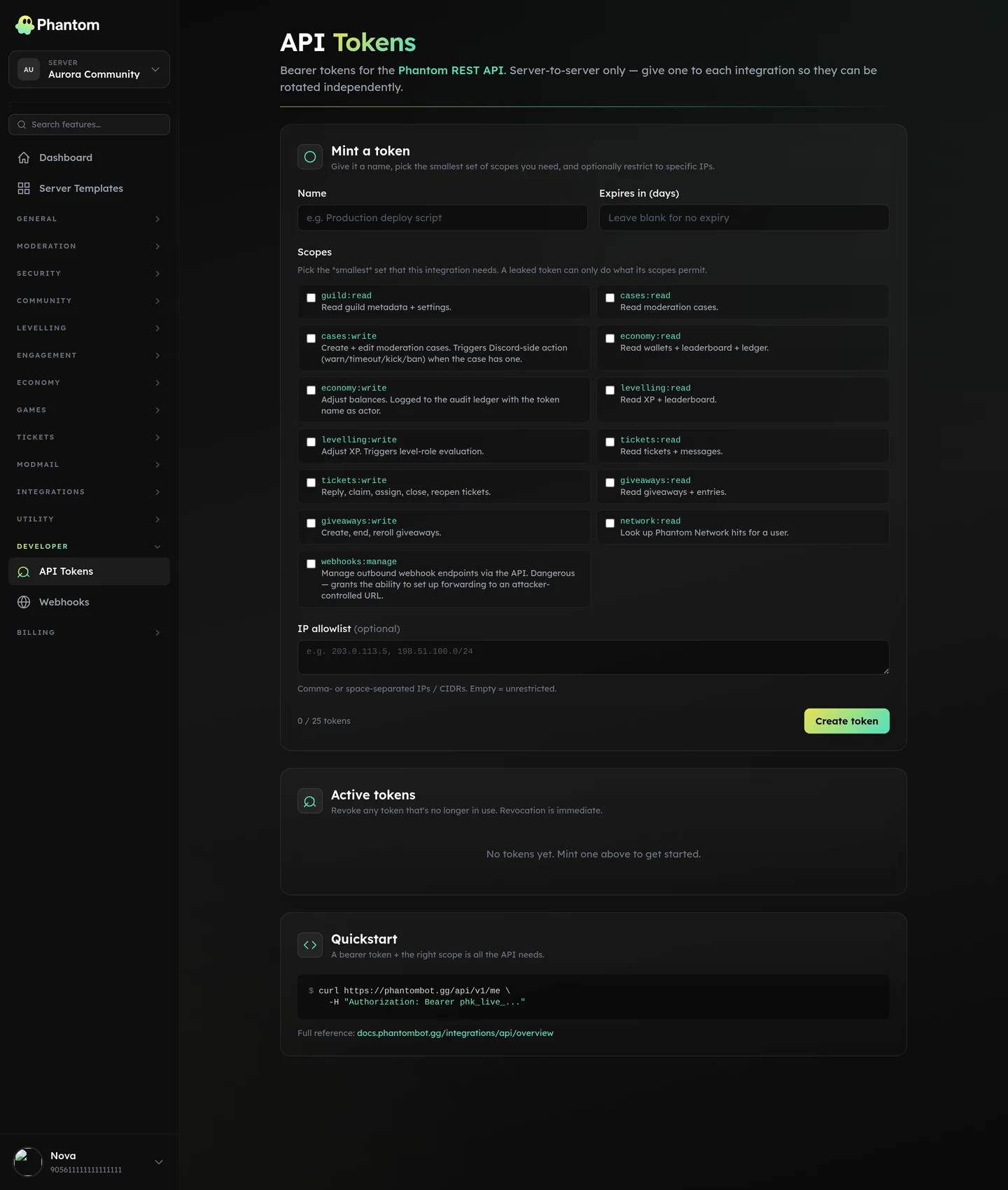 Developer → API Tokens.
It's designed for server-to-server integrations (your backend, a Zap, an n8n flow, a custom dashboard). It is not a browser API — there is no CORS, no cookie auth, and no JavaScript client SDK. Use a bearer token from a server you control.
At a glance
| Base URL | https://phantombot.gg/api/v1 |
| Auth | Authorization: Bearer phk_live_… |
| Transport | HTTPS only (HTTP is rejected) |
| Format | JSON in, JSON out |
| Versioning | URL-prefixed (/api/v1) |
| Rate limits | Per-token, separate read/write buckets |
| Idempotency | Stripe-style Idempotency-Key on writes |
| Webhooks | HMAC-SHA256 signed, retried with exponential backoff |
What you can do today
| Resource | Read | Write |
|---|---|---|
| Guild metadata + settings | ✅ | — |
| Moderation cases | ✅ | ✅ (note/warn) |
| Economy wallets + leaderboard | ✅ | ✅ (adjust balance) |
| Levelling XP + leaderboard | ✅ | — |
| Tickets | ✅ | ✅ (post a message, close) |
| Giveaways | ✅ | ✅ (end, reroll) |
| Phantom Network lookup | ✅ | — |
Every endpoint is scope-gated — see Authentication.
Five-minute quickstart
- Mint a token. Open your server's Developer → API Tokens page. Click Mint a token, give it a name, pick the smallest set of scopes you need, and click Create token. Copy the token immediately — it's only shown once.
- Confirm it works.bashYou should see your token's preview, scopes and guild id.
curl https://phantombot.gg/api/v1/me \ -H "Authorization: Bearer phk_live_xxxxxxxxxxxxxxxxxxxxxxxxxxxxxxxx" - Read something.bash
curl 'https://phantombot.gg/api/v1/cases?per_page=5' \ -H "Authorization: Bearer phk_live_…" - Subscribe to events. Open Developer → Webhooks, add an endpoint, copy the signing secret, and have your receiver verify the
Phantom-Signatureheader — see Webhooks.
Response shape
Every response is JSON. Successful responses carry the resource directly or under a data key for collections:
{
  "data": [ /* … */ ],
  "page": 1,
  "per_page": 25,
  "has_more": true
}
Errors always look like this:
{
  "error": {
    "code": "insufficient_scope",
    "message": "Missing required scope: cases:write.",
    "required_scope": "cases:write"
  }
}
See Errors for the full code catalogue.
What's next?
- Authentication — token format, scopes, IP allowlists
- Rate limits — buckets, headers, 429 handling
- Idempotency — making writes safe to retry
- Endpoints — full resource reference
- Webhooks — receiving events, signature verification
- Event catalogue — every event you can subscribe to
- Errors — every error code and what it means
- Security model — what the API can and can't protect you from