
Mention flood
Cap how many user or role mentions a single message can contain, and block raw @everyone / @here abuse.
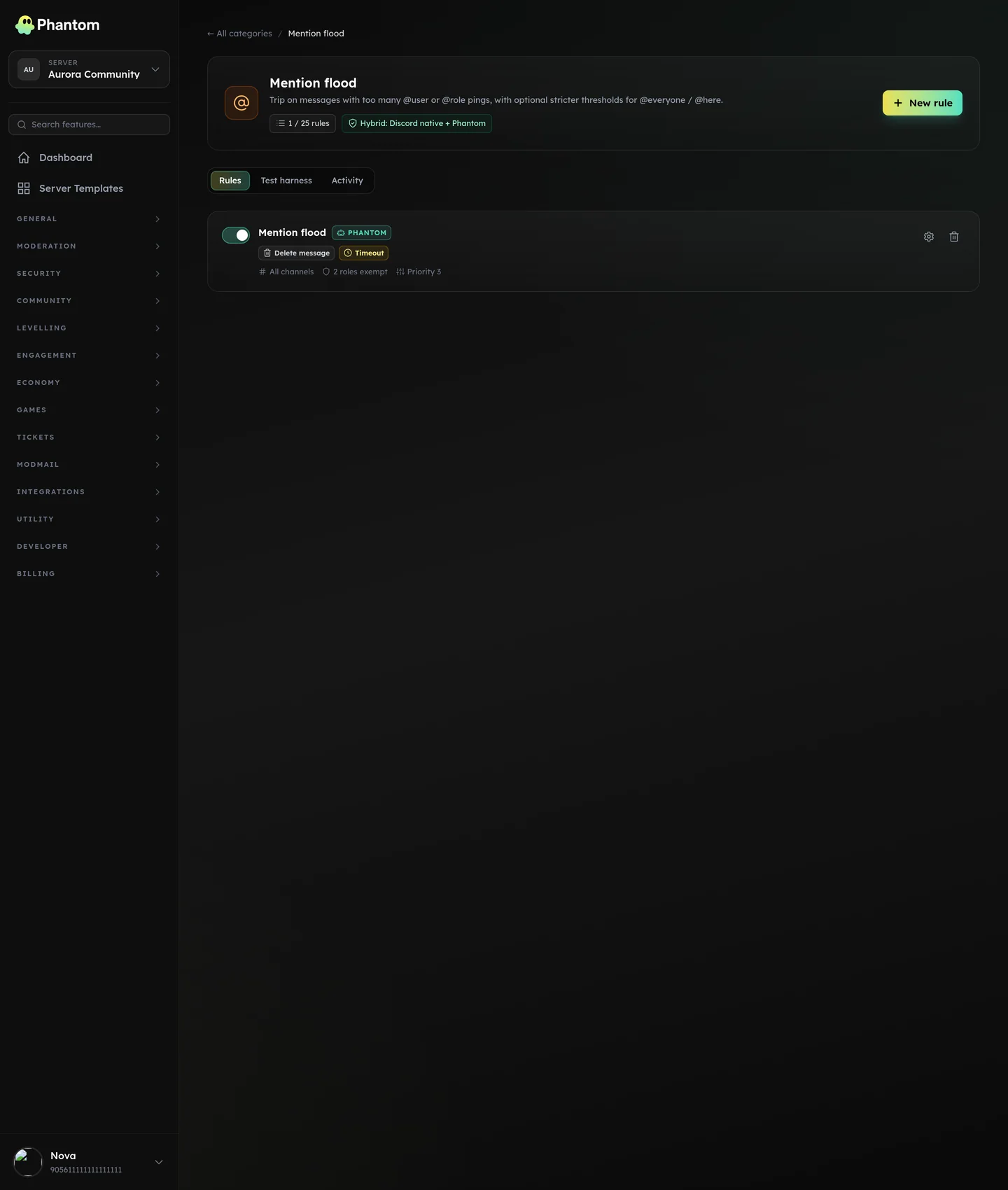 Automod → Mention flood.
When you'd use it
- Block ping-spam raids ("@user1 @user2 @user3…" copy-pasted lists)
- Stop a single member ping-bombing one channel
- Prevent
@everyoneabuse from accounts that somehow have the permission
Settings
| Setting | What it does |
|---|---|
| Block @everyone / @here | Catches the literal @everyone or @here in the message body, even if Discord didn't actually ping (e.g. the member doesn't have the permission). |
| Max user mentions | Maximum unique user mentions per message. Set to 0 to disable this check. |
| Max role mentions | Maximum unique role mentions per message. Set to 0 to disable. |
Tips
- 5 user mentions is a common sane default. Most legitimate messages mention 1–3 people. A message with 8 mentions is almost always either ping-spam or a list of credits — and the latter is rare enough to warrant a
log_onlyfirst-pass. - The user-mention count uses the maximum of two signals: regex match of
<@id>patterns ANDmessage.mentions.users.sizefrom Discord. So if a member sneaks in<@1234>as plaintext it still counts. - Role mentions can be more annoying than user mentions — a single
@Moderatorping wakes every moderator. Keep this aggressive (1–2 max). - The everyone/here check looks at the raw text — it fires even if Discord refused to actually send the ping. Useful for "didn't want to ping, did want to fool people into looking."
Common patterns
| Use case | Setup |
|---|---|
| Standard | max_user=5, max_role=2, block_everyone=ON |
| Strict | max_user=3, max_role=1, block_everyone=ON |
| Just stop @everyone abuse | max_user=0, max_role=0, block_everyone=ON |
Limits
- 6 actions per rule
Behaviour
- The check fires once per message (not per offending mention).
- Exempt roles bypass entirely — useful for
@Mod-Alertsstyle roles that legitimately fan out big mentions.
Related pages
- Automod overview
- Spam — for "many separate messages each with mentions"